
Choosing between an air cooler vs AIO is one of the most common build decisions, and the two technologies serve different practical needs. This comparison synthesizes nine ComponentCrate cooling reviews — single-tower and dual-tower air coolers plus 360mm liquid AIOs — to show how they differ on heat transfer, noise, case clearance, reliability and maintenance, so you can pick based on your CPU, case and preferences rather than on marketing.
As an Amazon Associate, I earn from qualifying purchases.
Two Ways to Cool a CPU
Tower air coolers and liquid AIOs move heat away from the CPU in fundamentally different ways, but the physics of the end goal is the same: get heat off the die and into the air of your case.
Tower air coolers. A tower cooler mounts a heatsink directly on the CPU. Heat moves from the processor into a copper base, along heat pipes, and into a stack of aluminum fins; one or more fans push air through the fins to carry that heat away. Single-tower designs (like the Arctic Freezer 36 or Thermalright Assassin X 120) are compact and simple; dual-tower designs (like the Noctua NH-D15 G2, Thermalright Peerless Assassin 120 SE, or Royal Pretor 130 Ultra) add a second fin stack and more surface area for higher heat capacity.
Liquid AIOs. An all-in-one liquid cooler uses a pump to circulate coolant through a cold plate on the CPU and out to a radiator, where fans dissipate the heat. The 360mm AIOs here (Arctic Liquid Freezer III Pro 360, ID-Cooling FX360 PRO, Lian Li Galahad II Lite 360) use three 120mm fan positions on a ~360–398mm radiator. A pump, tubing, coolant and radiator add components an air cooler does not have.
Neither technology is inherently “better” — they trade design complexity and case requirements against different strengths. For a broader framework on choosing, see our guide to choosing CPU cooling.
Thermal and Noise Evidence
The nine reviews contain real measurements, but they come from different testers, systems, and conditions, so the numbers cannot be treated as a single comparable benchmark. What they do establish is a consistent picture of performance tiers.
Thermal headroom. Documented independent results include: the Arctic Freezer 36 (single-tower) cooling up to ~219W on an i7-13700K and holding ~56.5°C over ambient in GamersNexus testing; the Thermalright Assassin X 120 (single-tower) handling ~225W on an i7-14700K; the Peerless Assassin 120 SE (dual-tower) rated by Tom’s Hardware as one of the best air coolers it has tested and keeping high-end CPUs in check; the Noctua NH-D15 G2 (dual-tower) sustaining the highest wattages TechPowerUp has recorded for an air cooler (242.6W on AM5, 323W on LGA1700); and the Thermalright Royal Pretor 130 family cooling over 259W on an i7-14700K and matching a budget 360mm AIO in the same stress test. On the liquid side, the Arctic Liquid Freezer III Pro 360 held 76.4°C on an i9-13900K at its 253W ceiling in Club386’s test, and the Lian Li Galahad II Lite 360 handled a 243W Ryzen 9 9900X well in independent testing. The ID-Cooling FX360 PRO ranked top-five on AMD and stayed competitive on Intel.
What this means. A 360mm AIO is not automatically cooler than every air cooler, and an air cooler is not automatically quieter than every AIO. The data show flagship dual-tower air coolers (NH-D15 G2, Royal Pretor) genuinely rival AIOs in many loads, while the most extreme sustained all-core workloads on flagship CPUs remain where a large AIO can hold an edge. Because these tests used different chips, power settings and environments, we do not rank all nine products against each other here.
Noise is equally situational. It depends on fan speed and design, pump operation (on AIOs), radiator airflow, case acoustics, CPU workload, and the test environment. Measured noise figures include roughly 53 dBA at max fan speed for the NH-D15 G2 (TechPowerUp), ~42.5 dBA at full speed for the Peerless Assassin family (GamersNexus), and ~57 dBA at max fan speed for the FX360 PRO (TechPowerUp). Several manufacturer ratings (such as ≤25.6 dBA for the Assassin X 120’s fan, 27/28.3 dBA for the Royal Pretor’s fans, 25 dBA for the Atmos II’s pump, and 29.8 dBA for the Galahad II Lite’s fans) are advertised fan or pump figures, not independently measured whole-cooler results, and are labeled as such in the table below.
Case Clearance and Mounting
Air coolers mostly ask for vertical clearance and memory clearance. Documented heights: 148mm (Assassin X 120), 155mm (Peerless Assassin 120 SE), 158mm (Royal Pretor 130 Ultra), 159mm (Freezer 36), and 168mm (NH-D15 G2). Single-tower models generally clear tall RAM; dual-tower models often need the front fan raised for very tall modules (the Peerless Assassin and Royal Pretor note ~40–44mm RAM limits, and the NH-D15 G2 suggests single-fan mode for tall memory). Verify your case’s CPU-cooler height limit and your memory height before buying.
360mm AIOs ask for radiator mounting space. You need a case with three 120mm fan positions (top, front, or side), plus enough depth for the radiator and fans together: the Arctic Liquid Freezer III Pro 360 uses a thick 38mm radiator (~63mm with fans), while the FX360 PRO and Galahad II Lite 360 use standard 27mm radiators (~52–55mm with fans). A case that “supports 360mm radiators” does not automatically fit every 360mm AIO — radiator thickness, fan thickness, tube routing, and clearance against the RAM or VRM heatsinks all matter. The four reviewed AIOs also differ in socket support: the Liquid Freezer III Pro 360 and Galahad II Lite 360 support only modern sockets (LGA1851/1700 + AM5/AM4), while the FX360 PRO adds LGA1200/115x, and the 240mm Atmos II Stealth adds LGA1200/115x too.
Reliability and Maintenance
Air coolers have very few moving parts: fans and a heatsink. Maintenance is routine — clearing dust from the fins, cleaning or replacing fans, and occasionally re-mounting. Several reviewed air coolers carry a 6-year warranty (Freezer 36, NH-D15 G2, Peerless Assassin, Royal Pretor). There is no pump, coolant, or tubing to fail.
AIOs add more potential failure points: the pump, the coolant loop, the tubing, and the radiator seals. While all four reviewed AIOs include a 6-year manufacturer warranty, a warranty is not a lifespan guarantee — we do not claim any AIO lasts a specific number of years. Routine maintenance means cleaning radiator and fan dust; component wear (most commonly the pump, or coolant aging and permeation over time) is a repair/replacement concern rather than ordinary cleaning. If long-term simplicity matters most, an air cooler removes the pump and liquid-loop variables entirely.
Which Cooler for Your Build
The comparison table below summarizes the documented specifications from the nine reviews. It is a specification and positioning reference, not a performance ranking — thermal and noise data come from different testers, so they are attributed rather than averaged.
| Type | Model | Height / Radiator Size | Fans | Socket Compatibility | Noise: Advertised vs Measured | Review |
|---|---|---|---|---|---|---|
| Tower air (single) | Arctic Freezer 36 A-RGB | 159mm tall (heatsink 104×126×159mm) | 2× 120mm P12 push-pull (200–2000 RPM) | LGA1851/1700, AM5/AM4 | Advertised: none dBA stated (fluid-dynamic fans). Measured: none independently documented. | Full review |
| Tower air (single) | Thermalright Assassin X 120 Refined SE | 148mm tall (120×46×148mm) | 1× 120mm TL-C12C (1550 RPM) | LGA115x/1200/1700/1851, AM4/AM5 | Advertised: ≤25.6 dBA (fan rating). Measured: not independently verified. | Full review |
| Dual-tower air | Thermalright Peerless Assassin 120 SE | 155mm tall (125×110×155mm) | 2× 120mm TL-C12C (1550 RPM) | LGA115X/1200/1700/1851, AM4/AM5 | Advertised: up to 25.6 dBA (fan rating). Measured: ~42.5 dBA at full fan speed (GamersNexus, PA120 family). | Full review |
| Dual-tower air | Thermalright Royal Pretor 130 Ultra Black | 158mm tall (130×112×158mm) | 2× S-FDB V2: 120mm front (2150 RPM) + 130mm middle (1750 RPM) | LGA115X/1200/1700/1851/2011/2066, AM4/AM5 | Advertised: 27 dBA front / 28.3 dBA middle (fan ratings). Measured: not independently verified (Tom’s praised noise-normalized behavior for the standard RP130). | Full review |
| Dual-tower air | Noctua NH-D15 G2 | 168mm tall (152mm deep with fans) | 2× 140mm NF-A14x25r G2 (1500 RPM max) | AM5/AM4, LGA1700/1851/1200/115x/1954 | Advertised: no dBA stated. Measured: ~53 dBA at max fan speed (TechPowerUp, independent). | Full review |
| 360mm liquid AIO | Arctic Liquid Freezer III Pro 360 A-RGB | 398×120×38mm radiator (~63mm with fans) | 3× 120mm P12 Pro A-RGB (600–3000 RPM) | LGA1851/1700, AM5/AM4 | Advertised: none dBA stated. Measured: ~19% quieter than predecessor at 1200 RPM (Club386, relative; no absolute dBA). | Full review |
| 360mm liquid AIO | ID-Cooling FX360 PRO | ~396×120×27mm radiator (~52–53mm with fans) | 3× 120mm PWM (~1830 RPM max, measured) | LGA1851/1700/1200/115x, AM5/AM4 | Advertised: none dBA stated. Measured: ~57 dBA at max fan speed (TechPowerUp, independent). | Full review |
| 360mm liquid AIO | Lian Li Galahad II Lite 360 Performance | 397×120×27mm radiator (~55mm with fans) | 3× FDB (200–2500 RPM) | LGA1851/1700, AM5/AM4 only | Advertised: 29.8 dBA (fan rating). Measured: audibly loud at 100% duty (EnosTech, independent observation; no dBA number). | Full review |
| 240mm liquid AIO (neither tower air nor 360mm AIO) | Cooler Master MasterLiquid Atmos II Stealth 240 | 277×119.2×29mm radiator | 2× Mobius 120P (690–2500 RPM) | LGA1851/1700/1200/115x, AM5/AM4 | Advertised: 25 dBA pump rating (manufacturer). Measured: whole-cooler noise not independently measured; fan acoustics mixed in reviews. | Full review |
The last row (Atmos II Stealth 240) is a 240mm AIO, which sits outside the tower-air versus 360mm-AIO scope; it is included for completeness and identified as such rather than forced into either category. All noise figures are labeled by source, and no manufacturer-claimed dBA is presented as an independent measurement.
Guidance by situation:
- Mainstream & budget builds: a quality single-tower or dual-tower air cooler (Freezer 36, Assassin X 120, Peerless Assassin 120 SE) is usually the most practical, quiet solution — no pump, radiator, or tubing, and documented capacity well above typical 125–200W CPUs.
- High-end CPUs under sustained all-core loads: a flagship dual-tower air cooler (NH-D15 G2, Royal Pretor 130 Ultra) rivals AIOs in most loads, but the most extreme sustained workloads can still favor a 360mm AIO.
- Noise sensitivity & full-load acoustics: don’t assume either class is quieter. The quietest reviewed units include the NH-D15 G2 and the FX360 PRO at moderate fan speeds; the Galahad II Lite 360 is loud at 100% duty. Set a sensible fan curve either way.
- Case constraints: choose an air cooler for cases with limited radiator space or to avoid thick-radiator clearance issues; choose a 360mm AIO only if your case genuinely fits the radiator + fans at the required thickness and position.
- Long-term simplicity: air coolers have the fewest failure points; AIOs add a pump and coolant loop, so weigh the 6-year warranties here against your tolerance for eventual pump/liquid-loop replacement.
For more context, see our best cooling solutions pillar and the CPU cooling reviews hub.
Shop Now

Noctua NH-D15 G2
Shop Now on Amazon

Thermalright Royal Pretor 130 Ultra Black
Shop Now on Amazon

Thermalright Peerless Assassin 120 SE
Shop Now on Amazon

Arctic Freezer 36 A-RGB
Shop Now on Amazon
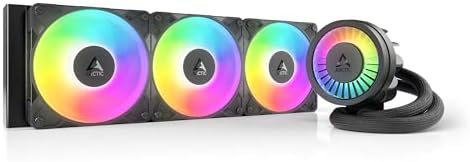
Arctic Liquid Freezer III Pro 360 A-RGB
Shop Now on Amazon

Lian Li Galahad II Lite 360 Performance
Shop Now on Amazon

ID-Cooling FX360 PRO
Shop Now on Amazon
As an Amazon Associate we earn from qualifying purchases.