
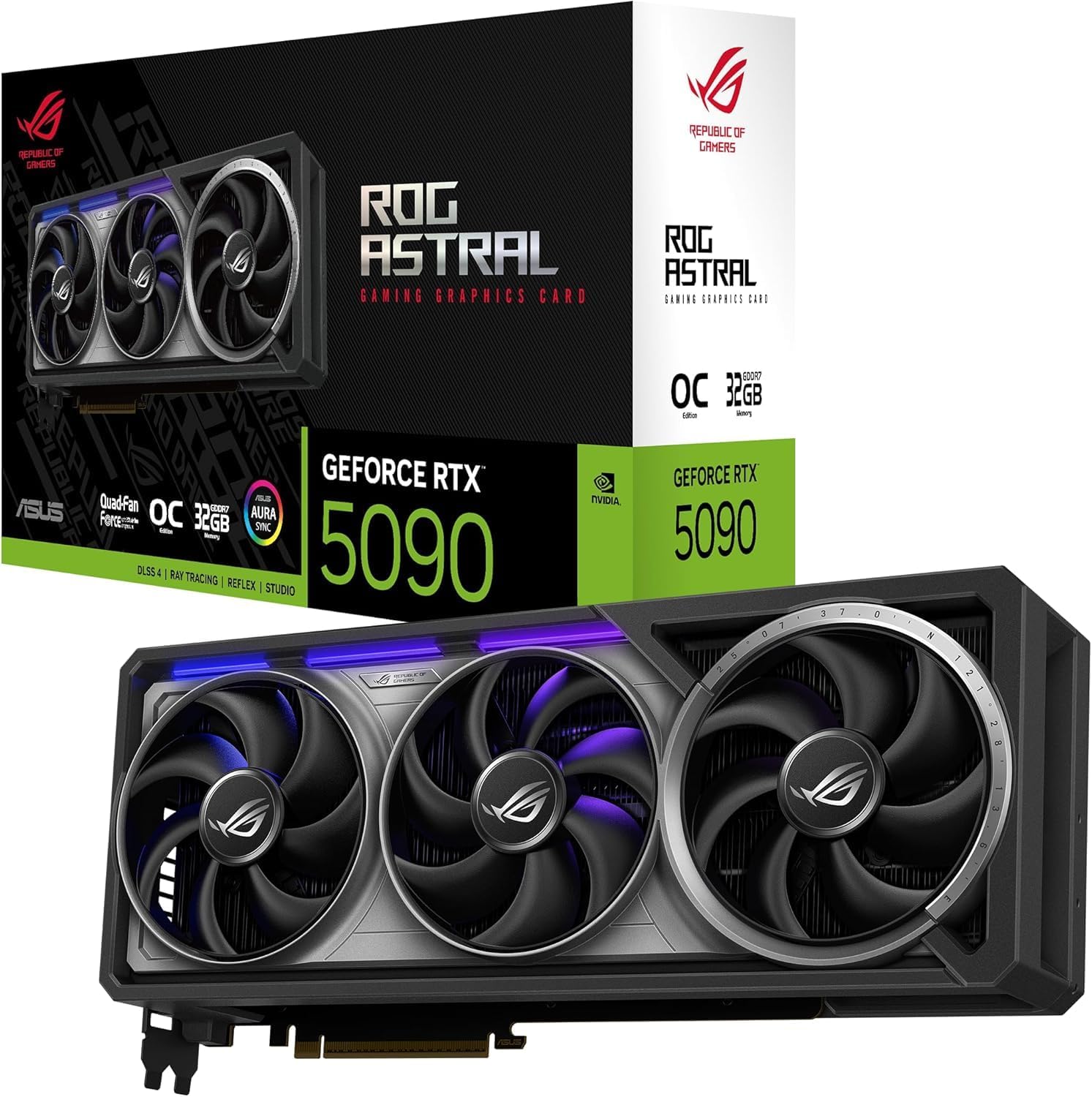
The NVIDIA GeForce RTX 5090 is the fastest consumer graphics card you can buy, and the ASUS ROG Astral GeForce RTX 5090 OC Edition (model ROG-ASTRAL-RTX5090-O32G-GAMING) is ASUS’s flagship interpretation of it. This is a big, heavy, all-metal, four-fan card packing 32 GB of GDDR7 memory, a factory overclock, and a 600 W power target — built for people who want the absolute most from a 4K (and beyond) gaming rig, and for creators and AI users who can put that VRAM to work.
The central question for this review isn’t whether the Astral is fast — it is, by a wide margin. It’s whether the premium ASUS charges for its top-tier 5090 is money well spent compared with other RTX 5090 designs, or whether the surcharge buys more badge than benefit. We’ll weigh the verified performance, cooling, noise, and value against the realistic alternatives.
Quick Verdict
- Best for: Enthusiasts who want the fastest air-cooled RTX 5090 with the lowest GPU temperatures and don’t mind a large, heavy, premium-priced card. Also strong for 4K/8K gamers and demanding creative/AI workloads that use the 32 GB VRAM.
- Main strengths: Class-leading 4K and ray-tracing performance from the RTX 5090 silicon; excellent thermals (about 22 °C cooler than the Founders Edition under load in TechPowerUp’s testing); 32 GB GDDR7; factory OC with a useful dual-BIOS and idle fan-stop; extra HDMI output and two synced fan headers.
- Main limitations: A large premium over the RTX 5090 Founders Edition; noise under load is not better than the much smaller reference card and lags quieter rivals like the MSI Suprim; huge 3.8-slot footprint (357 × 149 × 76 mm) requires a roomy case; very high power draw and a 600 W default power limit.
- Value assessment: As a product, the Astral delivers what it promises. As a value proposition, the premium buys a metal shroud, a fourth fan, and single-digit percentage real-world gains over a stock 5090 — which many buyers won’t find worthwhile. Amazon prices and availability can change, so check the current listing before deciding.
Key Specifications
| Attribute | ASUS ROG Astral RTX 5090 OC Edition |
|---|---|
| GPU | NVIDIA GeForce RTX 5090 (Blackwell) |
| CUDA cores | 21,760 |
| Memory | 32 GB GDDR7, 28 Gbps (512-bit bus, ~1.8 TB/s) |
| Boost clock | 2610 MHz (ASUS listing); 2580 MHz rated (TPU) |
| Power limit (default) | 600 W |
| Power connector | 16-pin (12VHPWR/12V-2×6) |
| Slot size | 3.8-slot |
| Dimensions | 357.6 × 149.3 × 76 mm (14.1 × 5.9 × 3.0 in) |
| Cooling | Four fans (three axial + backplate exhaust), all-metal cooler |
| BIOS | Dual BIOS (Performance / Quiet), idle fan-stop |
| Outputs | 2× HDMI 2.1b, 3× DisplayPort 2.1a |
| Interface | PCIe 5.0 (backward compatible) |
| Extra features | Two fan headers synced to GPU fans, backplate fan |
Boost-clock note: ASUS’s listing cites 2610 MHz; TechPowerUp’s review lists a rated boost of 2580 MHz and recorded real-world gaming clocks around 2809 MHz. Both are documented; the difference reflects advertised OC spec versus tested rating. No independent spec table here mixes measured and manufacturer figures.
Design and Build Quality
The Astral is unmistakably a premium flagship. ASUS moved away from a plastic shroud to an all-metal design with matte surfaces, and it feels solid — it has to, because this is a card that weighs over 3 kg and stretches 357 mm long, 149 mm tall, and 76 mm thick (3.8 slots). That makes it one of the larger and heavier GeForce cards available, and physical fit is a real purchasing consideration.
The signature design decision is the quad-fan layout: three standard axial fans on the main shroud plus a fourth fan mounted on the backplate that exhausts hot air directly. In TechPowerUp’s open-bench testing, this arrangement delivered very low GPU temperatures — about 65 °C under load in the Performance BIOS, roughly 22 °C cooler than the Founders Edition under the same load. It’s a physically imposing cooler that does its primary job extremely well.
Two practical touches stand out: a dual-BIOS switch (Performance and Quiet modes) and idle fan-stop, so the fans stop entirely at idle. ASUS also includes two fan headers that sync to the GPU fans, letting you run additional case fans that ramp with GPU temperature — a genuinely useful feature for builders tuning airflow around this card.
Features and Technology
- RTX 5090 (Blackwell) silicon: 21,760 CUDA cores and a 512-bit memory bus feeding 32 GB of GDDR7 at 28 Gbps for roughly 1.8 TB/s of bandwidth. This is the fastest consumer GPU available (manufacturer/silicon spec, corroborated by independent testing).
- 32 GB GDDR7 VRAM: More than any consumer card before it. For most games, the capacity matters less today, but it’s a real advantage for AI, machine-learning, 3D rendering, and other VRAM-hungry professional workflows.
- DLSS 4: Supports Multi-Frame Generation (which can triple or quadruple frame count) and the newer Transformer-based upscaling model, which independent reviews report is a major image-quality step up from the previous CNN model — and available on GeForce RTX cards with a modest performance trade-off.
- Factory overclock + dual BIOS: ASUS ships a higher boost clock and a 600 W default power limit (the maximum the 16-pin connector allows). The Quiet BIOS runs a relaxed fan curve at the cost of slightly higher temperatures and lower noise.
- Connectivity: Two HDMI 2.1b and three DisplayPort 2.1a outputs — one more HDMI than the reference card — plus PCIe 5.0 support (backward compatible with older PCIe generations).
- Attribution: silicon, VRAM, DLSS capabilities, clock, power limit, and BIOS features are manufacturer claims; the practical performance, temperature, noise, and efficiency results below are independent review data.
Performance and Real-World Use
In TechPowerUp’s testing (Ryzen 7 9800X3D test system, Windows 11 24H2, 4K rasterization without RT or DLSS), the RTX 5090 delivers roughly 41% higher performance than the RTX 4090, about twice the RTX 3090 Ti, and around 82% more than the RTX 4080 Super. It’s roughly 75% faster than AMD’s current flagship, the RX 7900 XTX. With ray tracing enabled, it’s about 32% faster than the RTX 4090 and roughly 2.5× the RX 7900 XTX.
The Astral’s factory overclock gives it a small edge: with a +7.2% clock bump over the reference, independent testing found about a 5% real-world improvement at 4K, and manual overclocking can add roughly another 5% on top. These are useful but modest gains — NVIDIA’s reference cards are already very well tuned out of the box, so the Astral’s performance advantage over a standard 5090 is single-digit percentages.
For the buyer, the practical takeaway: at 4K with maximum settings and ray tracing, this is the fastest experience you can build today, and DLSS 4 makes very high frame rates achievable. The catch is power: with a 600 W default limit (and measured draw that can exceed the rated adapter spec in some independent tests), this card demands a high-quality, high-wattage power supply and a case with serious airflow. Idle and multi-monitor power draw is also higher than average.
Compatibility and Installation
Check four things before buying:
- Case clearance: At 357 mm long, 149 mm tall, and 76 mm thick (3.8 slots), the Astral needs a large case with enough GPU length and tower clearance, and it may block neighboring PCIe slots. A roomy full-tower or large mid-tower is the safe choice.
- Power supply: ASUS recommends a high-wattage PSU (a fully overclocked system is their stated basis) with a native 16-pin (12VHPWR/12V-2×6) connector or a suitable adapter. Given the 600 W target, an 80 PLUS-rated unit sized for your CPU + this card is essential — do not undersize.
- Motherboard/PCIe: PCIe 5.0 is backward compatible, so it works in older boards, though you’ll want a modern board (and ideally a strong CPU) to avoid bottlenecks at high frame rates.
- Available slots/outputs: The 3.8-slot width means it will consume several expansion slots’ worth of space; plan your other expansion cards accordingly.
Advantages and Disadvantages
Pros
- Fastest consumer GPU class; superb 4K and ray-tracing performance.
- Very low load temperatures (≈65 °C) from the four-fan all-metal cooler.
- 32 GB GDDR7 VRAM for future-proofing, AI, and creative workloads.
- Factory overclock, dual BIOS, idle fan-stop, and two synced fan headers.
- Extra HDMI 2.1b output and PCIe 5.0.
Cons
- Large price premium over the RTX 5090 Founders Edition for a single-digit real-world performance gain.
- Not quiet under load: louder than several rivals (e.g., MSI Suprim) despite the big cooler.
- Huge, heavy 3.8-slot footprint limits case compatibility.
- Very high power draw; 600 W default limit and elevated idle power.
- Memory overclocking is artificially capped by the driver (per TechPowerUp).
No numerical price, currency, or range is included; value is assessed qualitatively.
Price and Value for Money
The Astral is positioned at the top of ASUS’s air-cooled 5090 lineup, and it carries a corresponding premium over NVIDIA’s reference card. The question is what that premium buys: an all-metal build, a fourth fan, very low temperatures, a factory OC, and a second HDMI port. Independent testing shows the real-world speed gain over a standard 5090 is roughly 5% out of the box (plus more if you overclock manually), while noise under load is not better than the much smaller reference card and is worse than quieter competitors.
So value is situational. If you want the fastest air-cooled 5090 with headline thermals and don’t mind the size and noise, the Astral is a legitimate (if expensive) choice. If you’re optimizing for dollars-per-frame, or for silence, other 5090 designs give up little performance for considerably less money and less noise. Because Amazon prices and availability can change — and because this specific listing may reflect a third-party seller’s price rather than the card’s typical street pricing — check the current listing on Amazon before you decide.
Best Alternatives and Comparisons
- NVIDIA GeForce RTX 5090 Founders Edition — The reference point. Much smaller (dual-slot) and less expensive, with nearly the same performance; it runs hotter and not any quieter under load. Choose it if you want 5090 performance in a more manageable package for less money.
- MSI GeForce RTX 5090 Suprim SOC — A direct premium rival. In TechPowerUp’s testing it was markedly quieter under load (≈28 dBA in its quiet mode vs ≈36–39 dBA for the Astral) with very similar performance and competitive thermals, generally at a lower price. Pick it if silence matters more than ASUS’s build and extras.
- MSI RTX 5090 Suprim Liquid SOC — For buyers willing to add an AIO, this delivers the lowest temperatures and excellent noise. A niche pick if acoustics and cooling are the absolute priority and you have the case space for a radiator.
Recommendations are based on verified independent test data relative to the reviewed card’s positioning; no monetary comparisons are made.
Who Should Buy It?
- 4K/8K gaming enthusiasts who want the fastest current GPU and a factory-tuned, top-of-the-line air cooler.
- Overclockers/tinkerers who’ll use the dual BIOS, synced fan headers, and extra OC headroom.
- Creators and AI users who genuinely use 32 GB VRAM and want a premium, durable build with a second HDMI output.
Who Should Consider Something Else?
- Value-conscious buyers: the premium over a standard 5090 buys little real-world speed — consider the Founders Edition or a more affordable partner card.
- Silence-focused builders: the Astral is not quiet under load; the MSI Suprim is a better pick.
- Small-form-factor / compact builders: the 3.8-slot, 357 mm card won’t fit many cases — plan your build around it or choose a smaller design.
- Anyone on a tight power budget: a 600 W-class card needs a substantial PSU and robust cooling.
Final Verdict
The ASUS ROG Astral GeForce RTX 5090 OC Edition is technically excellent: it delivers the fastest consumer graphics performance available, with very low temperatures and a premium, well-built cooler. Its limitations are equally clear — a steep price premium for a modest real-world performance gain, noise that lags quieter rivals, a huge physical footprint, and substantial power requirements.
Buy it if you want the absolute best air-cooled 5090, you value ASUS’s build and extras (dual BIOS, fan headers, extra HDMI), your case and PSU can handle a 3.8-slot, 600 W card, and the price doesn’t bother you. Compare alternatives — or check the current Amazon listing — if your priority is value or silence, because other 5090 designs deliver almost the same speed for less money and less noise.
Check the Latest Price on Amazon →
Related Guides
- Best GPUs for 1440p Gaming in 2026 — our tiered picks for this category
- How to Choose a Graphics Card
- Browse All Graphics Card Reviews